Sources: CDC (US stroke incidence), Stroke Association UK, National Aphasia Association.
Practice — rebuild the words
Four ways to bring vocabulary back.
A short daily routine, never a test. Each module targets a different part of how the brain finds and uses words.
Word finding
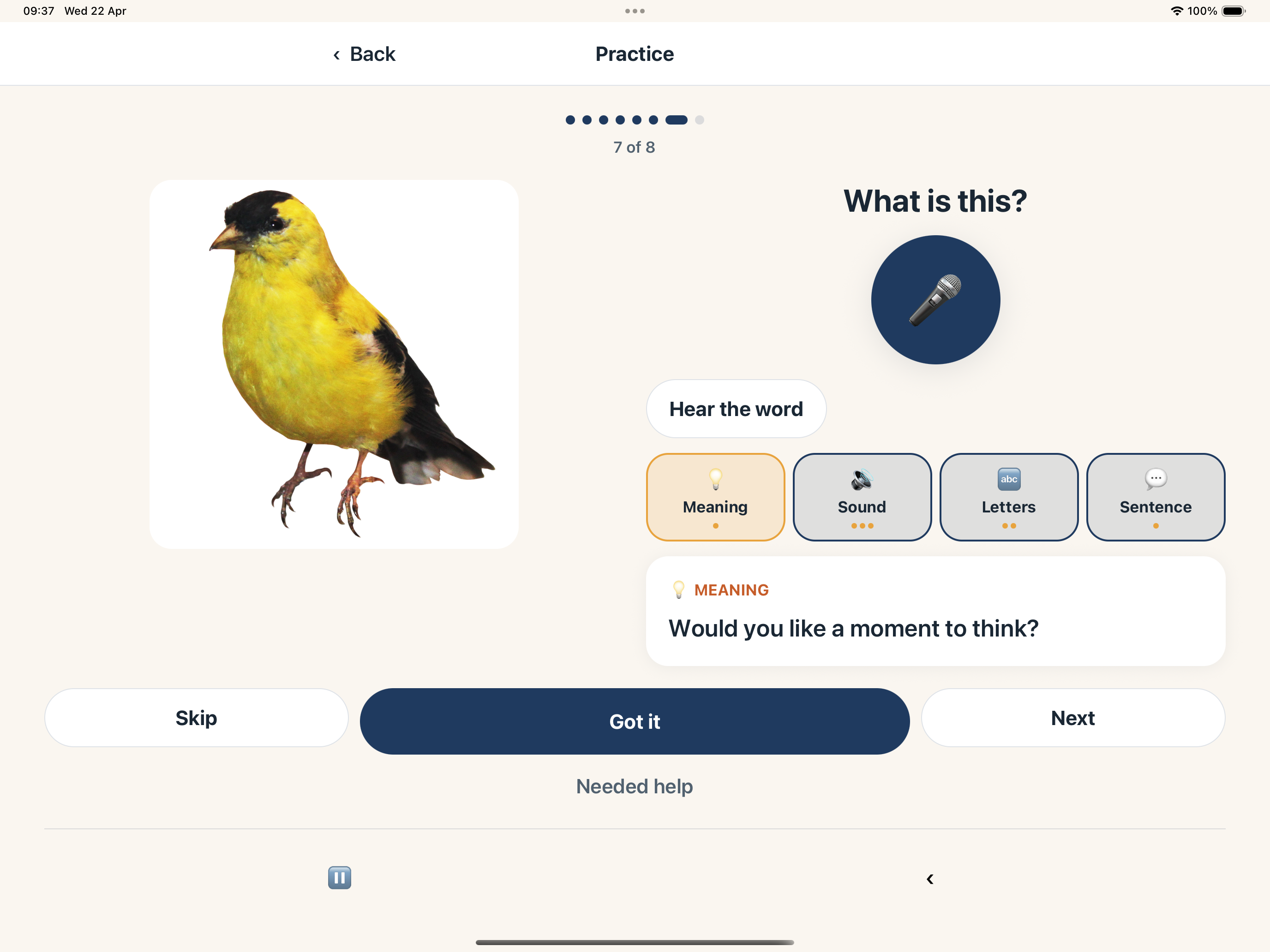
See a picture, try to say the word. Cues appear only if you stall — meaning, sound, syllables, sentence frame — never as a test.
Clinical basisCued naming with SFA + PCA hierarchy. Probe items refresh every two weeks to track untrained generalisation.
Listening
Hear a word, tap the picture that matches. Builds the comprehension side of the same vocabulary you practise speaking.
Clinical basisAuditory comprehension / single-word picture matching. Distractors selected from a different semantic category to keep the task discriminating.
Pairing
Tap two pictures that go together — fork and knife, dog and ball, soap and towel. Strengthens the meaning network around each word.
Clinical basisSemantic association / SFA-style thematic, categorical and functional pairing. Items rotate from a curated 200-pair manifest.
Sentence building
Build a simple everyday sentence around an action verb — "the dog is drinking the water." Helps speech come back in full sentences, not just single words.
Clinical basisVNeST (Verb Network Strengthening Treatment) — agents and patients elicited around a target verb.
A session that cues, never grades.
One word at a time, with the cues you want — the sound, the first letter, a sentence it fits into. Tap “Got it” when the word comes back, or “Needed help” when it didn’t. Either way you move on.
Progress is measured on words you haven’t practised, so the number going up means something real.
Talk & track
Stretch into real conversation.
Practice modules that bridge to everyday talk — your photos, your scripts, your own voice over time, and a calm AI partner to chat with.
Photo description
Tell us about your own photos — who's there, what's happening. We ask simple wh-questions grounded in the names and places you give us.
Clinical basisPersonalised narrative discourse with LLM-grounded wh-prompts. Uses your own people, places and events as the stimulus set.
Scripts
Practise the things you actually say — at the till, on the phone, when someone asks how you are. Stage by stage, with cues that fade.
Clinical basisScript training (Youmans/Holland) — listen → read along → with cues → solo → generalise.
Voice journal
Record once a month using the same simple prompt. Months later you can hear today's voice next to last year's — your own audio yardstick.
Clinical basisSelf-rated voice tracking. Consistent prompt, comparable across timepoints, optional CCRSA/CETI tagging at each entry.
Conversation partner
A calm AI partner you can talk with — the kind of low-pressure chat that's hard to find when speech is slow. It listens, waits, and offers a way in if you stall.
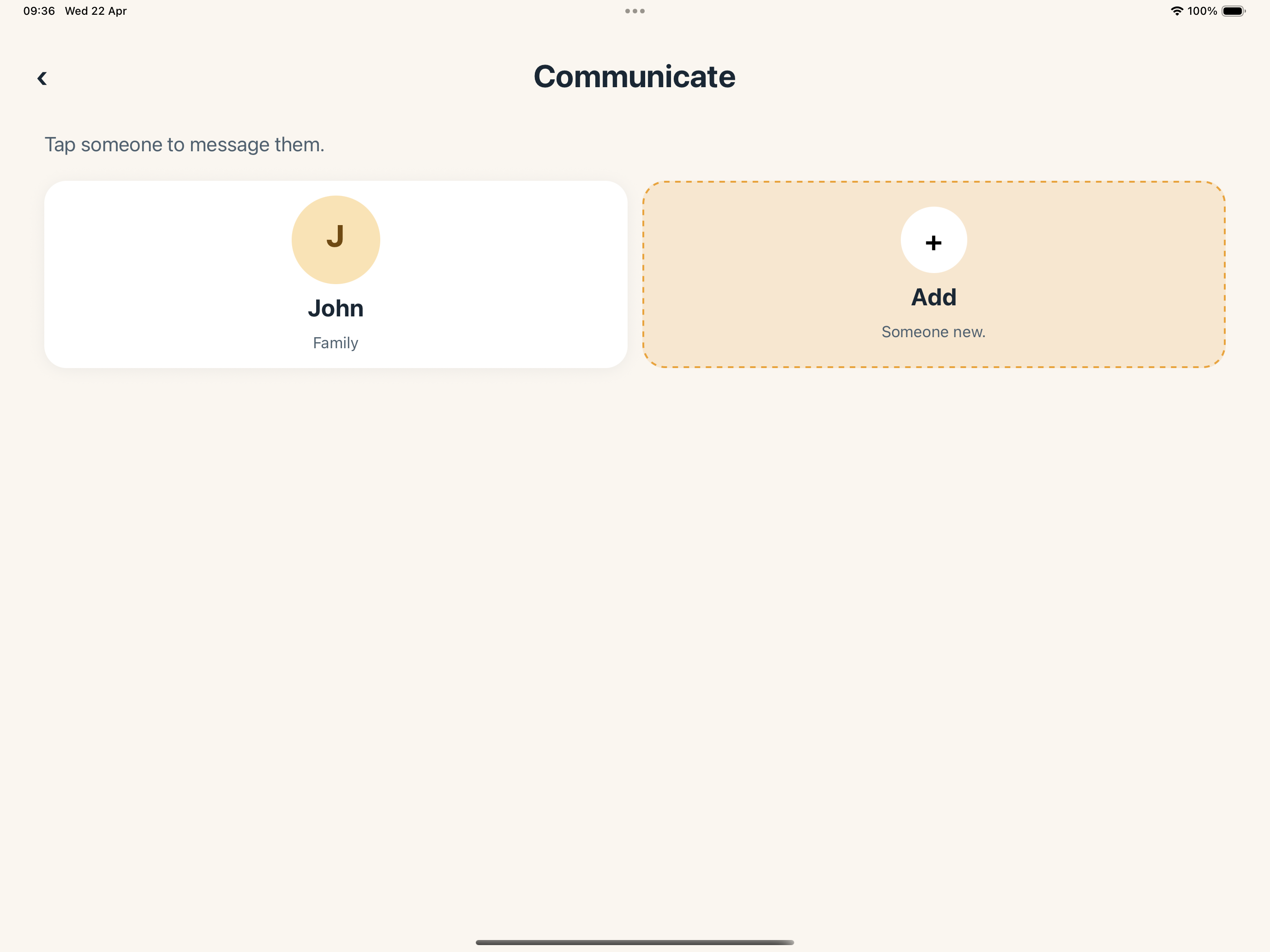
Pick whichever works today. Family don’t need the app — messages land in their WhatsApp, and their replies come back with a Listen button.
Speak it
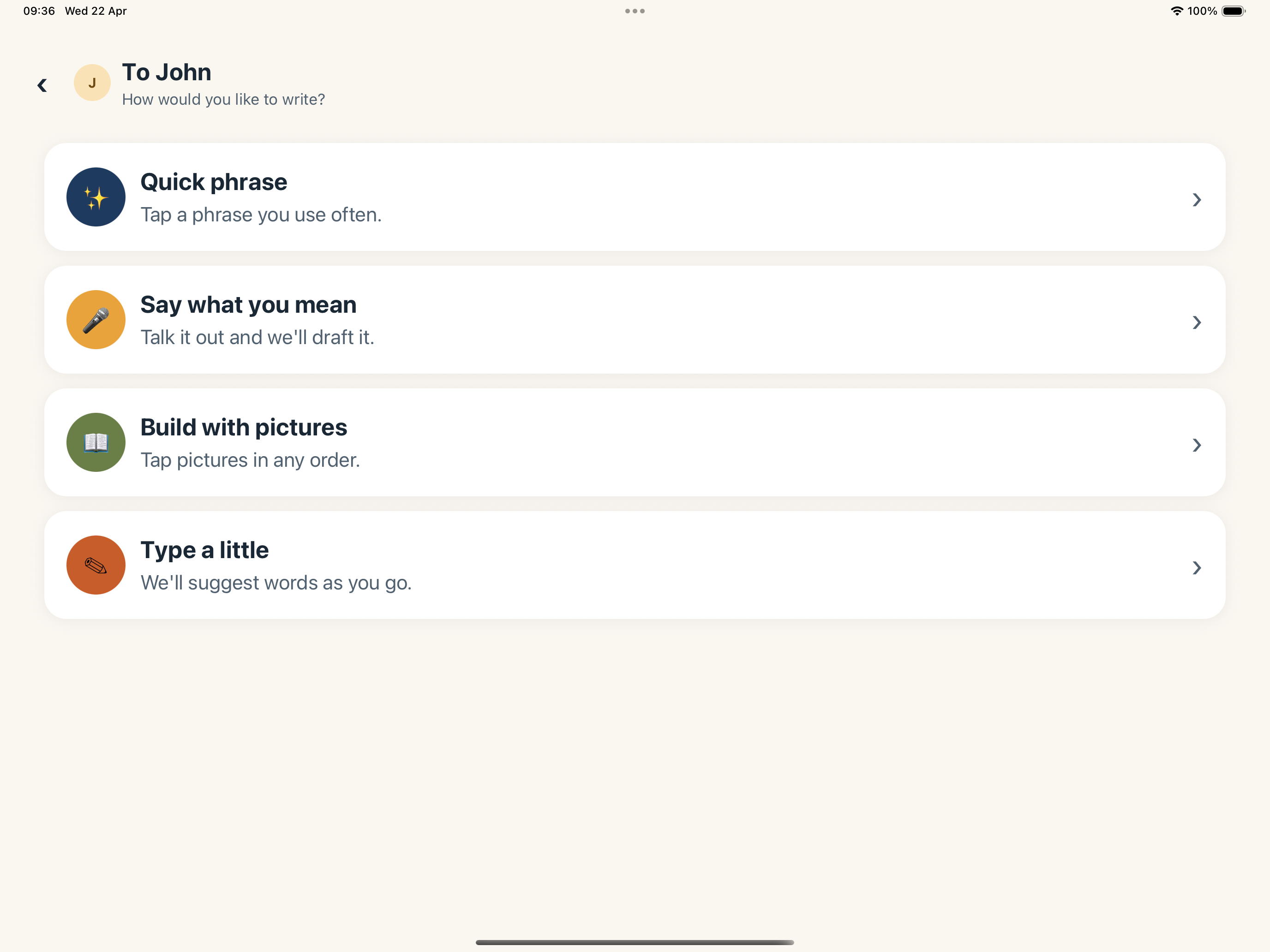
Tap the mic and talk however the day allows. We turn what you said into a clear sentence you can review, hear back, tweak word by word, and send.
Clinical basisAI-augmented AAC — speech captured verbatim, then drafted with the patient's own vocabulary and message history. Original audio always preserved.
Build with pictures
Tap a few pictograms — feelings, people, places, food — and we'll weave them into a sentence to send. When the words are stuck, the pictures aren't.
Clinical basisPictographic AAC. Library of ~3,500 Mulberry Symbols, organised by daily life scenes.
Aided typing
Word suggestions seeded from your own past messages, forgiving of typos, and an AI sentence completion when you've written a few words.
Clinical basisPredictive AAC. Personal corpus + LLM disambiguation; gentle nudge to switch to speech if stuck.
Quick phrases
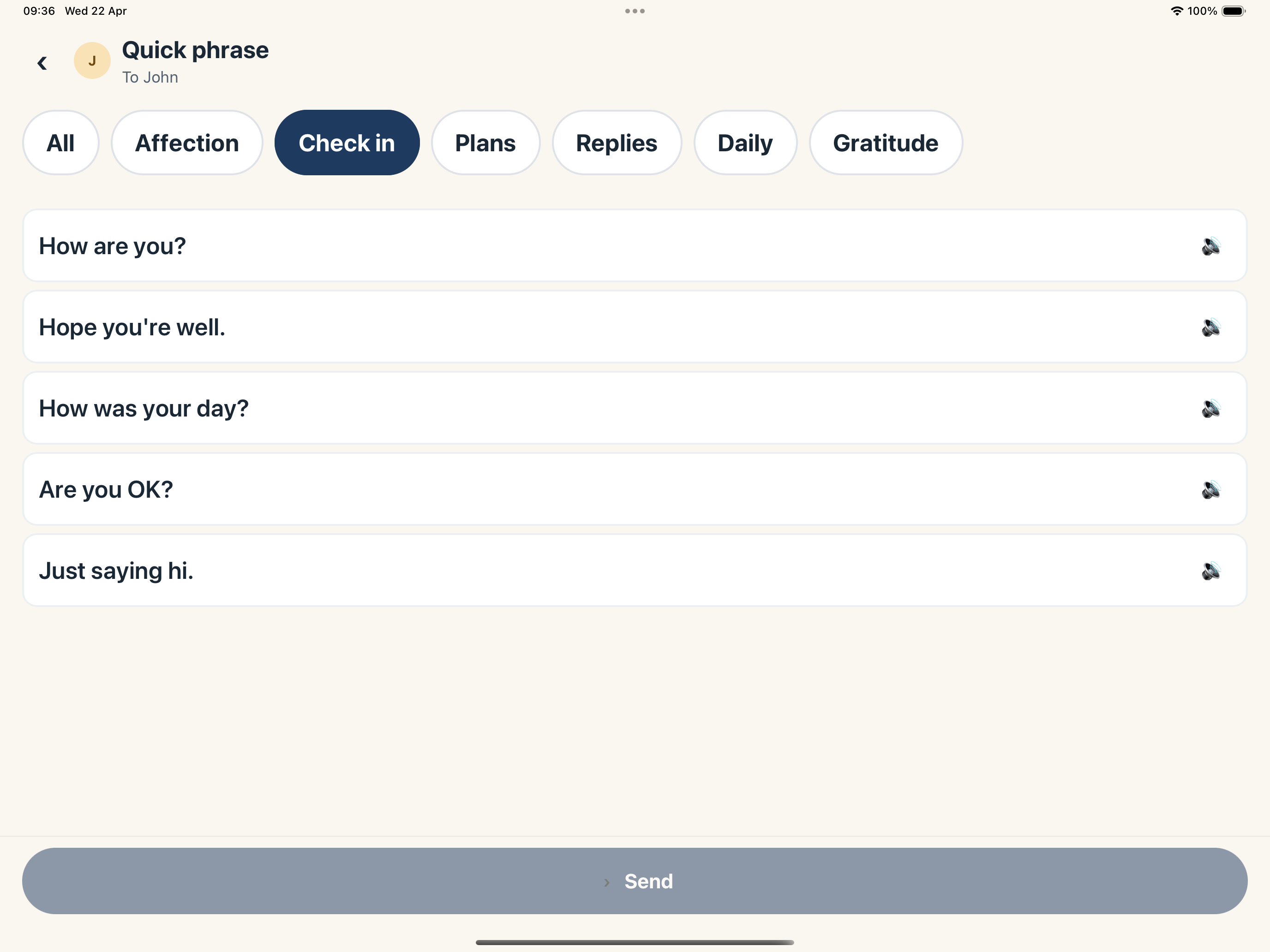
Thirty ready-to-send phrases in six everyday categories — affection, checking in, plans, replies, daily, gratitude. One tap, one preview, one send.
Clinical basisFunctional phrase library. Categories aligned with everyday conversational acts; expandable per user.
For family, clinicians and progress
The bits that hold it all together.
How carers stay in the loop, how we measure real change, and the small details that make practice feel less like a test.
Carer dashboard
Family see practice rhythm, recent wins and a shareable progress report — without taking over the account. Access is yours to give and yours to revoke.
Clinical basisConversation Partner Training (Kagan / SCA). Carer view scoped by patient-controlled permissions.
Monthly check-in
Two short questionnaires once every four weeks. Tracks how confident you feel and how well everyday conversations are going.
Clinical basisCCRSA (Communication Confidence Rating Scale for Aphasia) + CETI (Communication Effectiveness Index). MDC thresholds applied — we only call it progress when the change is real.
Functional wins
Log the small everyday wins — a phone call that worked, a coffee ordered, a name remembered. They're celebrated and shared with your carer.
Clinical basisGoal Attainment Scaling-lite. Self-reported life-participation outcomes; categorised and time-stamped.
References for CCRSA, CETI, VNeST, SFA, PCA, CIAT and Script Training are on the evidence page.
Why we built it
We built it for mum
After her stroke, 2 left side strokes within 10 days (m1/m2) - the harder thing to watch was her trying to find the words she wanted but couldn't, without a lot of prompts.
We tried apps. Practice apps rebuilt words in a vacuum, didn't help with sentences or phrases. None of them helped her talk to us, on the days the words wouldn’t come, so I built an app with 8 different practice couses. WhatsApp integration - easy prompts, large text, image driven messaging options. With AI back-end so practices are always evolving and not static, helping her recovery.
With 8 practice courses and a messaging application, StrokeVoice helps when speech is hard. It helps with practice and lets her send a message, via prompts, phrases, photos, or an AI-drafted sentence to anyone — straight to their WhatsApp - two-way messaging.
— John, developer
Download it free
A calmer daily routine — and the conversations, back.
Free to try for 14 days. £12.99 a month, £99 a year, or £149 a year for a family plan. Your voice stays yours — read our privacy approach.